At a glance
- 01
Audit first
We count every fixture, note its hours and condition, and quote from real numbers.
- 02
Controls that earn their keep
Occupancy sensors, daylight dimming and schedules where rooms sit empty or bright.
- 03
Incentive-aware
We point you to the current Save on Energy offers before products are bought.
- 04
Phased around operations
Area by area, so the store, plant or school keeps working.
Lighting is one of the few building upgrades where the savings are easy to see. An LED lighting retrofit replaces fluorescent tubes, metal halide high-bays, high-pressure sodium yard lights and old compact fluorescent downlights with LED equivalents that use a fraction of the power and last far longer. We plan and install retrofits for commercial, industrial and institutional buildings across Waterloo Region.
Three ways to retrofit
There is more than one way to get to LED, and the right choice depends on the age of the fixtures and how long you plan to keep them.
- Plug-and-play tubes: LED tubes that run on the existing fluorescent ballast. Quick, but you still own an ageing ballast that will fail.
- Ballast bypass tubes: the ballast is removed and the sockets are wired straight to line voltage. Cheaper to run over time, but the fixture must be relabelled so nobody puts a fluorescent tube back in.
- Retrofit kits: an LED panel or strip that installs into the existing housing. Kits must be certified for the fixture they go into.
- New fixtures: the right answer when housings are yellowed, rusted or in the wrong place, and for most high-bays and exterior lights.
Controls and occupancy sensors
LEDs turn on instantly and dim smoothly, which old metal halide fixtures never did. That makes controls far more useful.
Occupancy and vacancy sensors shut lights off in washrooms, storage rooms, meeting rooms and warehouse aisles when nobody is there. Daylight sensors dim fixtures near windows and skylights. Scheduling turns a sales floor or office down after hours. At the top end, networked lighting controls tie every fixture into one system that can be adjusted from a computer and report energy use. We recommend what makes sense for each space, not the most elaborate option for every room.
What it looks like by building type
Offices and retail: troffers and downlights replaced or converted, sales-floor lighting improved for colour, and back-of-house rooms put on sensors.
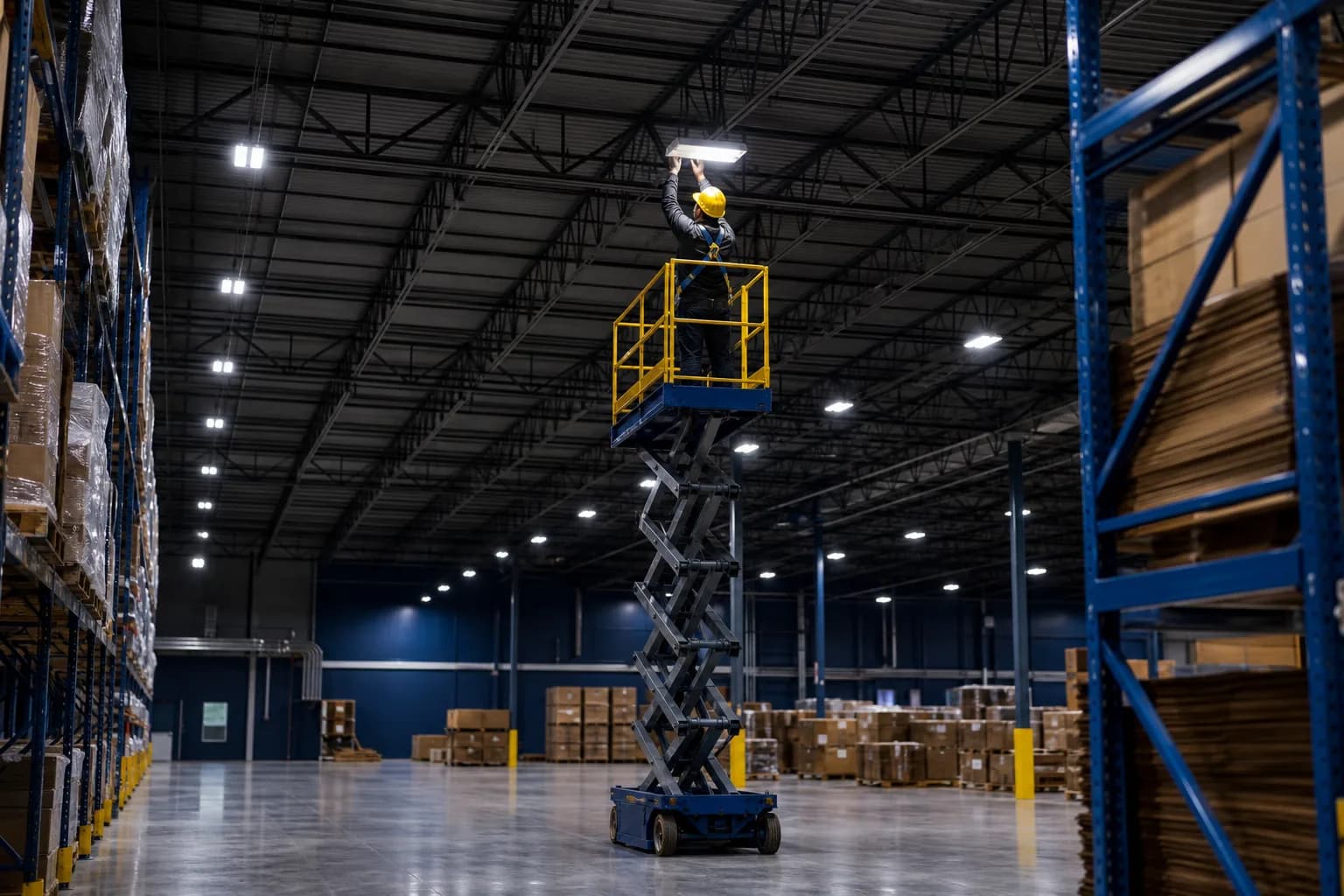
Warehouses and plants: metal halide and T5 high-bays replaced with LED high-bays on sensors, so aisles light only when a forklift arrives. Better uniformity also makes labels and racking easier to read.
Schools, clinics and public buildings: classrooms, gyms and corridors converted, with attention to glare and flicker. Exterior pole and wall lights can be done at the same time with our bucket truck.
Light quality, not just watts
A cheap LED that saves power but makes a space look flat or harsh is a poor trade. We look at colour rendering, so products and skin tones look natural; colour temperature, kept consistent across a space instead of a mix of warm and cool; glare from bare diodes at eye level; and uniformity across a floor so there are no dark patches between fixtures. Over-lighting is common after a careless retrofit, and a lower-output fixture or a dimming setting often fixes it while saving more.
Save on Energy incentives
Ontario’s Save on Energy programs, delivered by the Independent Electricity System Operator, have supported lighting upgrades for years, and the details change. As of autumn 2026, the Instant Discounts Program offers point-of-sale discounts on eligible LED tubes, high-bay and low-bay fixtures, recessed downlights and standard lighting controls such as occupancy sensors, bought through participating distributors for existing commercial, industrial, institutional, agricultural and multi-unit residential buildings. It does not apply to new construction, and products have to be installed within a set time after purchase. Networked lighting controls fall under the separate Retrofit Program.
Amounts and eligible products are revised regularly, so check saveonenergy.ca for what is current before you commit, and make sure products are bought in a way that qualifies. We will tell you which parts of a proposal are likely to be eligible and leave the application decisions with you.
How we run a retrofit
- Audit: a walk-through counting fixtures by type, noting operating hours, ceiling heights and the condition of each area.
- Proposal: fixture-by-fixture recommendations, controls where they fit, and a phased schedule.
- Notification: ESA is notified of the work under our licence.
- Installation: one area at a time, around shifts, store hours or the school calendar.
- Inspection and commissioning: ESA inspects; we set sensor timeouts and sensitivity so they don’t switch off on someone working quietly.
- Cleanup and recycling: old fluorescent tubes contain mercury, so they go for recycling rather than the bin, and the work areas are cleaned.
For a retrofit proposal built on your building, request a free quote or call 519-591-1442. We work throughout Kitchener, Cambridge and Waterloo.
Questions people ask
Should I replace the tubes or the whole fixture?
If the fixtures are in good condition and in the right places, LED tubes or certified retrofit kits are usually the better value. If housings are damaged, yellowed or the layout no longer suits the space, new LED fixtures make more sense.
Are there incentives for LED lighting in Ontario?
Save on Energy has offered discounts on eligible LED products and lighting controls for existing non-residential and multi-unit buildings, plus support for networked controls through its Retrofit Program. The offers change, so check saveonenergy.ca before buying.
Do occupancy sensors work in warehouses?
Yes, especially with LED high-bays, which turn on instantly. Sensors in each aisle light it when a person or forklift enters and dim or shut off after a set time, which cuts the hours the lights run.
Can a retrofit be done without shutting the business down?
Usually. We work area by area, scheduled around opening hours, shifts or the school calendar, so most of the building stays lit and in use while we work.