At a glance
- 01
GFCI-protected
Ground fault protection on the tub’s circuit, so a fault trips before it can hurt anyone.
- 02
Disconnect in the right spot
Readily accessible, lockable and at least 1.5 m from the tub unless behind a permanent barrier.
- 03
Inspected before backfill
We book ESA so the trench is checked, then closed, without days of open ground.
A hot tub combines water, people and a 240 V heater, so the code is strict about how it is fed. Hot tub wiring is a job we do every spring and summer across Kitchener, Waterloo and the townships, from a simple circuit to a patio tub beside the house to a long buried run to a swim spa at the back of a rural lot.
What the tub needs
Start with the spec sheet. Most full-size tubs run on 240 V and want a dedicated circuit, often in the 40 A to 60 A range, sized from the nameplate rather than the brochure. Some smaller plug-and-play tubs run on a standard 120 V receptacle and come with a GFCI cord, but they still need a dedicated outdoor receptacle in the right spot. Swim spas can need two circuits. We check the panel has the capacity and space, and if it doesn’t, we look at options before suggesting a panel upgrade.
GFCI protection
A ground fault circuit interrupter compares the current going out with the current coming back. If even a small amount leaks, through a damaged heater element or a person, it trips in a fraction of a second. The tub’s supply is GFCI-protected, typically by a GFCI breaker in the disconnect box near the tub. Test it monthly with the test button; if it won’t trip or won’t reset, call us before using the tub.
Where the disconnect goes
The disconnect lets you, or a service technician, cut the power to the tub. ESA’s guidance on the Ontario code sets out where it can go:
- It must be readily accessible, and outdoors when the tub is outdoors.
- If it is out of sight of the tub, it must be lockable in the off position.
- It can’t be closer than 1.5 m to the inside wall of the tub, unless a permanent barrier stops someone in the water from reaching it.
- If it sits within 3 m of the tub, it must be GFCI-protected by a device located at least 3 m from the tub.
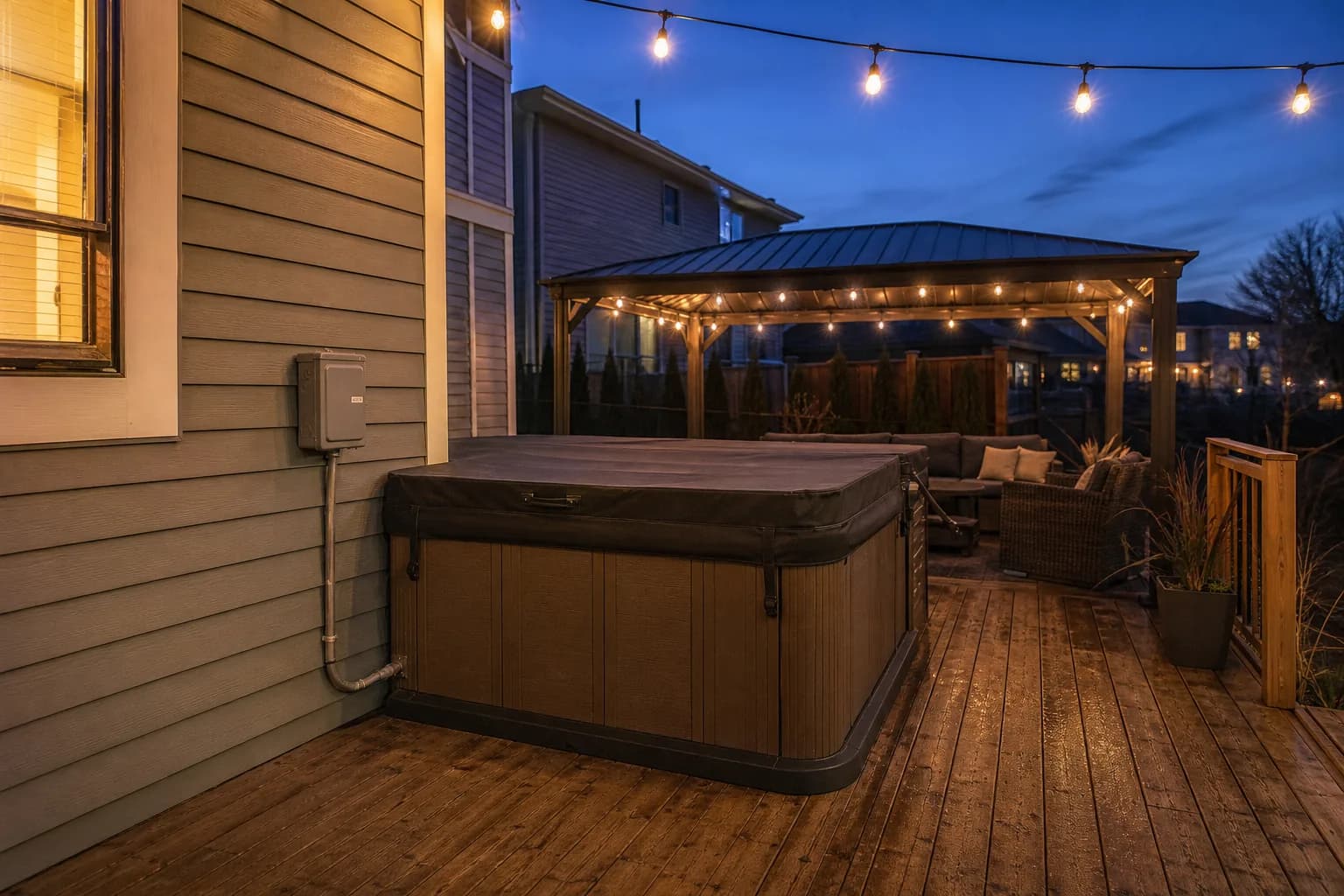
In practice, most of our installs put the disconnect on the house wall or a post a few metres from the tub, where it can be seen and reached but not from the water.
Getting the cable to the tub
When the tub isn’t right against the house, the circuit goes underground. Table 53 of the code sets the minimum cover, measured from the top of the cable or conduit to finished grade, and that depth depends on the wiring method and where it runs. Laying mechanical protection, such as treated planking or concrete, over the cable in the trench lets the cover be reduced by 150 mm. We use marking tape above the cable so a future fence post or garden doesn’t find it the hard way.
If the same trench carries a gas line to a heater or barbecue, the two services are kept 300 mm apart horizontally. Before digging, we arrange a utility locate.
ESA has to see the buried wiring before the trench is filled. We schedule that inspection with the dig so the yard is only open for as long as it needs to be.
Before the tub arrives
- Send us the model’s electrical specifications and the spot you have in mind.
- We visit, confirm the route and the disconnect location, and quote.
- The pad or deck is built, and we trench and lay the cable.
- ESA inspects the open trench, then it is backfilled.
- After delivery, we make the final connection, test the GFCI and confirm the heater runs.
Overhead lines and placement
Check what is above the spot before the tub is delivered. The code sets clearances between hot tubs and overhead conductors, and some utilities don’t permit their lines over a tub at all. Underground wiring near a tub has its own clearances too. If the service wires cross the backyard, talk to us before choosing the location.
Indoor tubs, decks and condos
A tub on a deck or in a sunroom adds questions about bonding, ventilation and the deck’s structure. Townhouses and condos usually need board approval as well. We go through what applies on the site visit.
Permits
New hot tub wiring needs an ESA notification and inspection, and we file it under our licence. Our guide to ESA permits and inspections explains how the process works. The Certificate of Acceptance is worth keeping for your insurer and for whenever you sell.
Tell us the tub model, where it will sit and roughly how far that is from your panel, and request a free quote. Or call 519-591-1442. We serve Kitchener, Waterloo, Wilmot, Woolwich and North Dumfries.
Typical prices
CAD · before GST/HST
- Hot tub circuit, GFCI and disconnect3 published prices; two are starting prices
- $500 to $2,500
- ESA notification, hard-wired hot tubContractor fee, up to two visits, ESA 2026 fee guide
- $168
Published prices from Ontario electrical contractors’ own price guides, checked October 25, 2026: ranges, not quotes, and before HST. ESA fees are from ESA’s own 2026 fee guide. Your job gets a written quote after we see it.
Questions people ask
How much does it cost to wire a hot tub?
Published Ontario prices for a hot tub circuit are $500 to $2,500. The distance from the panel, trenching versus a run along the house, and whether the panel has room all change the price.
How far does the hot tub disconnect need to be from the tub?
At least 1.5 m from the inside wall of the tub, unless a permanent barrier prevents someone in the tub from reaching it. If it is within 3 m, it must be GFCI-protected by a device at least 3 m away. It must also be readily accessible.
Do I need an ESA permit to wire a hot tub?
Yes. A new circuit and disconnect for a hot tub needs a notification filed with the Electrical Safety Authority and an inspection, including the underground wiring before the trench is backfilled.
How deep does hot tub wire need to be buried?
The minimum depth comes from Table 53 of the Ontario Electrical Safety Code and depends on the cable or conduit used and where it runs. Mechanical protection over the cable lets the depth be reduced by 150 mm. We confirm the right depth for your yard.
Can I plug my hot tub into a regular outlet?
Only if it is a 120 V plug-and-play model designed for it, and even then it should be on a dedicated, properly located outdoor receptacle. Full-size 240 V tubs must be hard-wired through a disconnect.