At a glance
- 01
Sized to your loads
We list what has to run in an outage, including starting surges, before choosing a size.
- 02
No backfeed, ever
Approved transfer equipment so the generator can never energize the utility’s lines.
- 03
Gas by a certified fitter
Natural gas or propane connections are made by a TSSA-certified gas technician.
- 04
Sized from your list
We size it from what you need to keep running, not from the biggest unit on the lot.
Ice storms, summer thunderstorms and the odd equipment failure all knock the power out around Waterloo Region now and then. For a house with a sump pump, a well, a home office or someone on medical equipment, even a few hours matters. If you are looking for a Generac installer in Kitchener, or another brand, we do the electrical side of generator installation, standby and portable.
We install and wire the unit that suits the house, and we will happily talk you out of a bigger generator than you need.
Standby or portable
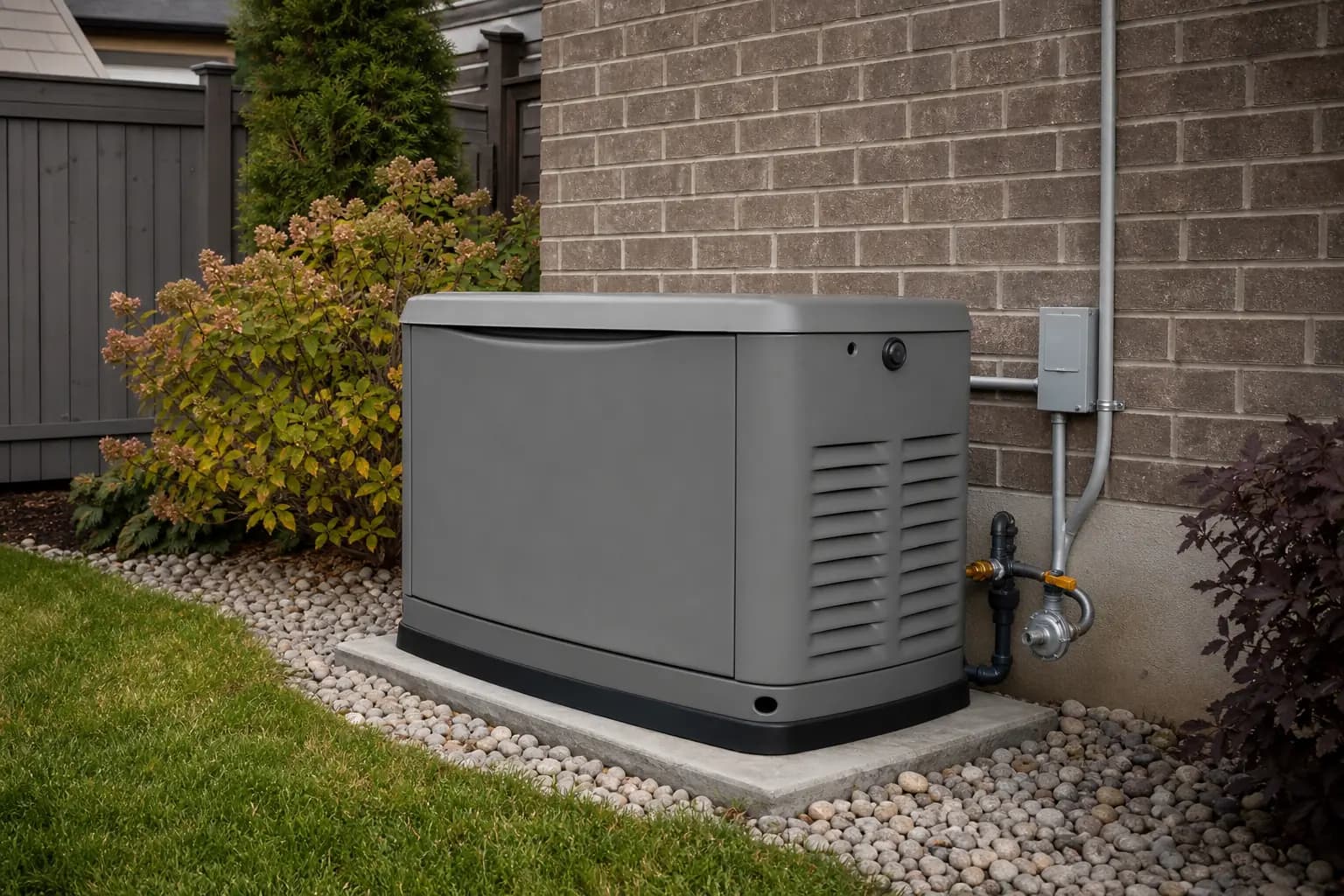
A standby generator sits permanently outside on a pad, runs on natural gas or propane, and starts by itself within moments of an outage. An automatic transfer switch moves the house over to generator power, then back again when the grid returns. You don’t have to be home.
A portable generator runs on gasoline, lives in the garage, and has to be wheeled out, started and plugged in. It costs far less and is perfectly good for keeping the fridge, the furnace and a few lights going, as long as it is connected the right way.
Connecting a portable generator safely
A generator plugged into the house wiring without proper transfer equipment can push power back out through the meter onto the utility’s lines, where crews are working on what they believe is a dead circuit. The same backfeed can damage the generator when the grid comes back. Homemade double-ended cords break the code and put lives at risk.
The safe options are a manual transfer switch with a small sub-panel of chosen circuits and an inlet box on the outside wall, or other transfer equipment certified for use in Canada that makes it impossible to connect both sources at once. Some interlock kits sold online are not certified for Canadian panels, so we only install certified equipment that suits your panel.
Sizing
We size a generator from a list of what needs to run, not from the size of the house. For each load we note its running power and, for motors, the extra surge it takes to start.
- Essentials: furnace blower, sump pump, fridge and freezer, a few lights and outlets, internet.
- Comfort: central air or a heat pump, which is often what pushes the size up.
- Rural loads: a well pump and water treatment, which are both essential and hard-starting.
- Whole house: everything on the panel, using a service-rated transfer switch and a load calculation.
A generator that covers essentials can be much smaller than a whole-home unit. Some standby systems also shed lower-priority loads automatically, so a mid-size generator can handle the air conditioner by switching off the dryer.
Placement
A standby generator needs a level base, clearances from windows, doors, vents and the gas meter set by the manufacturer’s instructions and the gas code, and enough room to service it. Exhaust carries carbon monoxide, so it never goes in a garage or under a deck. Some municipalities have rules on placement and noise; we check yours before the pad is poured.
The gas connection
In Ontario, gas piping and appliance connections must be done by a gas technician certified by the Technical Standards and Safety Authority (TSSA). We coordinate with a certified gas fitter, who runs and tests the gas line to the generator. On natural gas, the existing meter has to have enough capacity for the furnace, water heater and generator running together, which the gas fitter confirms with your gas utility.
ESA and start-up
Wiring a generator or transfer switch is electrical work that needs an ESA notification. We file it, ESA inspects, and once the gas side is complete the generator is started, tested under load and set to run its scheduled self-test. You get a walk-through of what happens in an outage and how to shut it down.
Living with a standby generator
A standby unit is an engine, and like any engine it needs care. Plan on regular oil and filter changes and a yearly service by a technician who works on that brand, following the manufacturer’s schedule. Keep snow and leaves cleared from the enclosure in winter, and listen for the scheduled self-test so you know it is still running. If the control panel shows a fault, have it looked at before the next storm rather than during it.
For backup power planned around your house, request a free quote with a list of what you would like to keep running, or call 519-591-1442. We work across Kitchener, Woolwich, Wilmot, North Dumfries and the rest of the region.
Typical prices
CAD · before GST/HST
- Standby generator, fully installedTypical of 3 published prices ($7,000 to $15,000 overall), 3 sources
- $7,000 to $15,000
- Whole-home standby generatorTypical of 2 published prices ($15,000 to $35,000 overall), 2 sources
- $16,500 to $30,000
- Interlock or transfer switch for a portable generatorTypical of 4 published prices ($400 to $1,500 overall), 3 sources
- $600 to $1,500
Published prices from Ontario electrical contractors’ own price guides, checked October 25, 2026: ranges, not quotes, and before HST. ESA fees are from ESA’s own 2026 fee guide. Your job gets a written quote after we see it.
Questions people ask
How much does a standby generator cost installed?
Published Ontario prices for a home standby generator, installed, are $7,000 to $15,000. The generator’s size, the transfer switch, the distance from the panel and the gas line all affect the total.
What size generator do I need for my house?
It depends on what you want to run, not on the square footage. Essentials like the furnace, sump pump, fridge and lights need a much smaller unit than a whole house with central air. We size it from a list of loads, including motor starting surges.
Can I plug my portable generator into a dryer outlet?
No. Feeding a house through an outlet with a double-ended cord can backfeed the utility’s lines and seriously injure line workers. A portable generator needs an approved transfer switch or other certified transfer equipment.
Who connects the natural gas line to a standby generator?
A TSSA-certified gas technician. Electricians wire the generator and transfer switch; the gas piping and connection are separate, regulated work, and we coordinate the two.
Do you install Generac generators?
We install and wire standby generators, Generac among them, and portable generator transfer equipment. Tell us the model you are considering, and check what the manufacturer requires for warranty registration.