At a glance
- 01
Phased, not gutted
Rewiring done floor by floor through basements, attics and small openings, while you keep living there.
- 02
Insurance paperwork
An ESA Certificate of Acceptance at the end, which is what insurers ask to see.
- 03
Aluminum done properly
Approved aluminum-rated devices or copper pigtails with connectors listed for the job.
- 04
Old-house experience
Plaster and lath, balloon framing and decades of additions are normal for us.
Knob and tube was the standard way to wire a house in Ontario from the late 1800s until about the 1940s, and plenty of it is still working, or half-working, behind the plaster. We handle knob and tube removal in Kitchener, Cambridge and Waterloo by rewiring the house in phases, and we also fix the other wiring that worries insurers: aluminum branch circuits from the late 1960s and 1970s, and ungrounded two-wire cable.
How to spot knob and tube
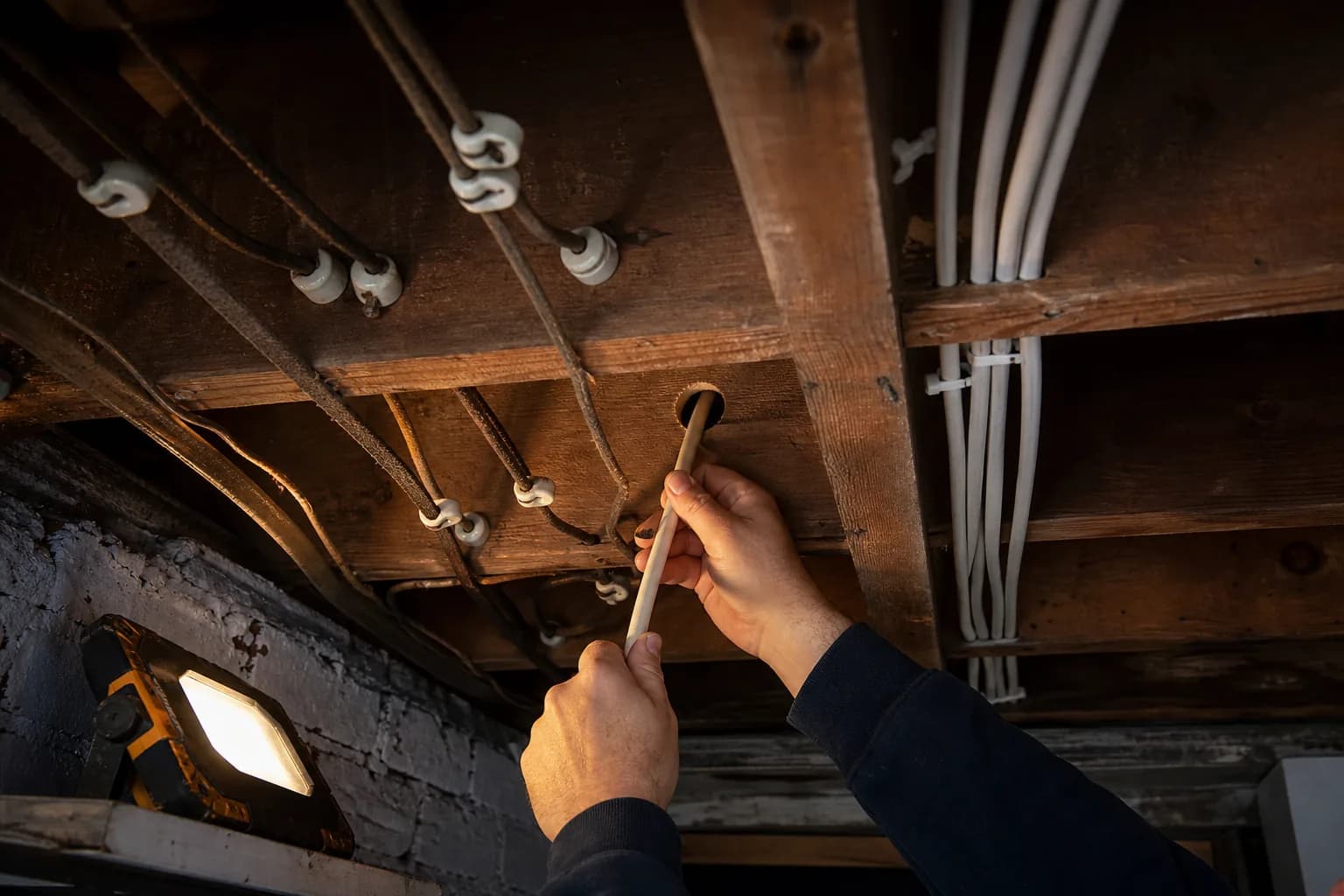
- In the basement: white porcelain knobs nailed to the joists with single wires wrapped around them, and porcelain tubes where the wires pass through wood.
- Cloth-covered wire: two separate conductors running a few inches apart, rather than one sheathed cable.
- Two-prong outlets: ungrounded receptacles throughout the older part of the house.
- A fuse panel: often, though not always, still in place.
- In the attic: knobs on the joists, sometimes buried under blown-in insulation.
If you see newer sheathed cable in the basement, don’t assume the job is done. Many houses were partly rewired, and knob and tube often survives in walls and ceilings upstairs. On a site visit we trace circuits from the panel and tell you how much of the old system is still live.
Why insurers care
Knob and tube wasn’t badly designed for its time, but it is now very old. The rubber and cloth insulation turns brittle and cracks, there is no ground conductor, and it was meant to shed heat into open air. Decades of insulation blown over it, amateur splices and overloaded circuits are where the risk comes from. Insurers can’t see inside your walls, so many of them decline to cover homes with active knob and tube, add a surcharge, or set a deadline for replacing it. Ask your insurer exactly what they need; usually it is proof that the old wiring has been disconnected and replaced, which the ESA certificate provides.
Older housing stock in the region
In general terms, you are most likely to find knob and tube in the oldest parts of the area: the original cores of Kitchener and Waterloo, and the historic downtowns of Galt, Preston and Hespeler in Cambridge, plus farmhouses and village homes in the townships. Brick and frame houses built before the Second World War are the usual suspects. Aluminum branch wiring shows up later, in some houses and townhomes built roughly between the mid-1960s and the late 1970s.
Rewiring a house with as little damage as possible
Opening every wall is rarely necessary. We plan the rewire around the house’s own structure:
- Panel first: usually a new panel or service, so the new circuits have somewhere to go. See panel upgrades.
- Basement and main floor: new cable run up from the basement into the walls above, using the open joists below.
- Upper floors: fed down from the attic, through top plates, to the outlets and switches below.
- Tricky spots: small, square openings where a wire has to pass a fire block or a beam, cut neatly so a plasterer or drywaller can close them quickly.
- Disconnect the old: every knob and tube circuit is traced, disconnected at the panel and made dead, so nothing old stays live.
We normally rewire one area at a time, so most of the house keeps power each day. Removing baseboards or using closets to hide a run are tricks we use often.
Aluminum wiring
Aluminum branch wiring itself isn’t illegal, and it doesn’t always need to be torn out. The problem is at the connections. ESA has warned that where the original outlets and switches aren’t marked for aluminum, connections can fail and overheat without any warning sign. The fix is one of two things: replace each device with one rated for aluminum (marked CO/ALR), or add short copper pigtails joined to the aluminum with connectors approved for aluminum-to-copper connections. Push-in terminals are never used with aluminum. Older boxes are sometimes too small for the extra connectors, so an extension box may be needed.
One Kitchener couple who bought an older home had us take it all on:
Jason Einwechter and his team were amazing! My husband and I recently bought a 'fixer upper' and Einwechter Electric handled all of the rewiring, new panel install, and smart home upgrades. Professional, tidy, and on time every day. Highly recommend. – L and R, Kitchener
Every rewire is filed with ESA and inspected before walls are closed; the knob and tube replacement cost guide explains what drives the price. If you have just bought an older house or your insurer has sent a letter, request a free quote or call 519-591-1442. We serve Kitchener, Cambridge, Waterloo and the surrounding townships.
Published prices
CAD · before GST/HST
- Whole-house rewire / knob and tube replacementTypical of 4 published prices ($8,000 to $50,000 overall), 4 sources
- $9,500 to $25,000
- Targeted circuit removal, per circuit
- $400 to $800
- Aluminum wiring pigtailing, whole homeTypical of 4 published prices ($800 to $8,000 overall), 4 sources
- $2,300 to $4,800
Published prices from Ontario electrical contractors’ own price guides, checked October 25, 2026: ranges, not quotes, and before HST. ESA fees are from ESA’s own 2026 fee guide. Your job gets a written quote after we see it.
Questions people ask
How much does it cost to replace knob and tube wiring?
Published Ontario prices for a whole-house rewire, including knob and tube replacement, are $9,500 to $25,000. The size of the house, how much old wiring is left and access through the attic and basement drive the price. Our knob and tube replacement cost guide explains the factors.
Do I need to move out while my house is rewired?
Usually not. We rewire in phases, a floor or a few rooms at a time, so most of the house has power each night. You may need to clear furniture from the rooms being worked on and live around some patched openings for a while.
Can I get home insurance with knob and tube wiring?
It depends on the insurer. Some won’t insure a home with active knob and tube, some add a surcharge, and some give a deadline to replace it. Your broker can tell you what your insurer requires.
Is aluminum wiring dangerous?
The aluminum wire itself isn’t the main problem; the connections are. Devices that aren’t rated for aluminum can loosen and overheat. Making every connection with aluminum-rated devices or approved copper pigtail connectors deals with that risk.
How long does a full rewire take?
A typical older house takes from several days to a few weeks, depending on its size, how much old wiring remains, and how much access there is through the basement and attic. We give you a schedule with the quote.