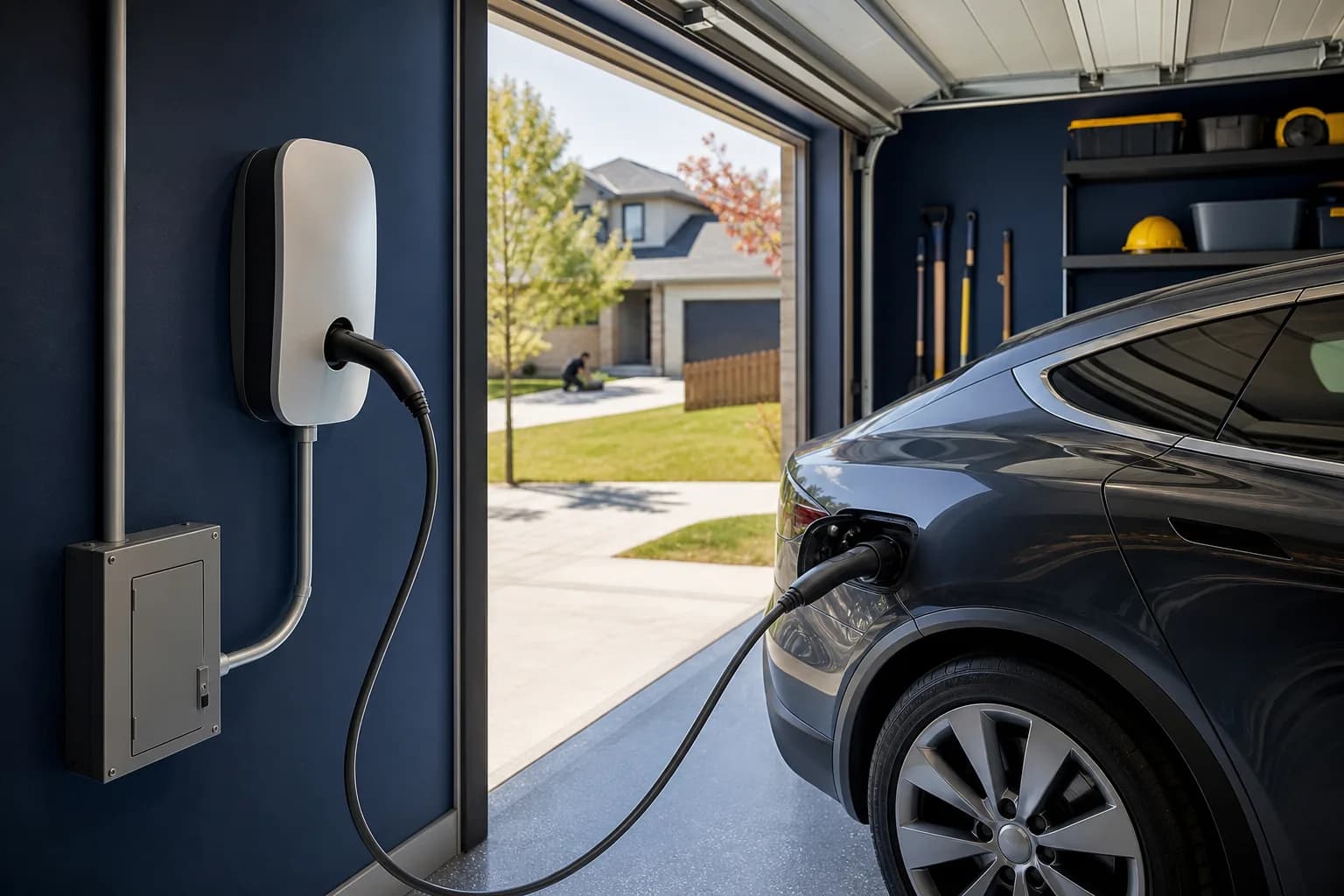
A Level 2 home charger connects to your electrical system in one of two ways. A plug-in unit has a cord with a NEMA 14-50 plug (sometimes a 6-50) that goes into a 240 volt receptacle, like the outlet behind many electric ranges. A hardwired unit has the circuit wired straight into it. Both charge the car the same way. The differences are in how much current you can use, what the code asks of each, and how they cope with a driveway in an Ontario winter.
The short answer
- Choose hardwired if you want the fastest charging your car accepts, if the charger will be outdoors, or if your panel is tight and you want the charger set to match a smaller circuit.
- Choose plug-in if you want to take the charger with you when you move or swap it later, and 32 to 40 amps of charging covers your driving.
How much current each one allows
A charger draws its full output for hours, so the circuit is sized at 125 percent of the charger’s output. Put the other way, the charger uses 80 percent of the breaker. Tesla’s installation table shows the pattern: a 60 amp breaker supports 48 amps of output, a 50 amp breaker 40 amps, and a 40 amp breaker 32 amps.
A 14-50 receptacle is a 50 amp device, and ESA Bulletin 86-1-7 says a cord-connected charger on a 14-50R or 6-50R must be protected by a 50 amp breaker. That caps a plug-in charger at 40 amps. ChargePoint’s Home Flex, for example, limits its plug-in versions to 32 or 40 amps, while the hardwired version accepts breakers from 20 to 80 amps and delivers up to 50. Tesla’s Wall Connector goes further: its installation manual says not to use a cord-and-plug connection at all.
The car has a say too. Every EV has a maximum AC charging rate set by its onboard charger, so check yours before paying for capacity it can’t use.
Circuit sizing and your panel
Either way, the charger needs its own circuit. Rule 86-300 requires a separate branch circuit for EV supply equipment unless an energy management system is installed. And either way, it counts in the home’s load calculation at 100 percent of its rating, which is why a 48 amp charger is a harder fit on a 100 amp service than a 32 amp one. Our guide to 100 amp vs 200 amp service explains the calculation, the utility-data route and load management.
This is where hardwiring has a quiet advantage. ESA allows a charger’s adjustable setting, whether a dial, DIP switch or commissioning app, to count for circuit loading only on fixed-in-place equipment, meaning a unit that needs a tool to remove. The setting has to be locked away from the user and labelled on or next to the charger. A hardwired charger set to 32 amps on a 40 amp circuit is a recognized installation. A plug-in unit that lifts off its bracket and unplugs fits ESA’s description of fastened-in-place instead, so its dial setting can’t be used to justify a smaller circuit.
Rule 86-304 requires a separate disconnecting means only for chargers rated more than 60 amps or more than 150 volts to ground, so a typical home charger on a 120/240 volt service doesn’t need an extra disconnect switch.
GFCI protection and receptacles
Much of the advice online is written for the United States, so check which code it follows. Under the OESC, Rule 26-704 requires Class A GFCI protection for 5-15R and 5-20R receptacles installed outdoors within 2.5 metres of finished grade. ESA Bulletin 26-18-15 states that the rule doesn’t apply to other receptacle configurations. Where an ordinary 5-20R receptacle is installed for a Level 1 charger in a home, ESA Bulletin 86-1-7 says the usual AFCI, GFCI and tamper-resistance rules apply to it.
Many home chargers also carry ground-fault protection of their own. FLO lists an integrated 20 mA GFCI on its home units. ChargePoint warns that a GFCI breaker ahead of a plug-in charger can cause nuisance tripping, and recommends a hardwired install where local rules call for one. We confirm what the current code edition requires for your location before we quote.
A plug-in charger also puts a receptacle under heavy load for hours at a time. FLO builds a heat sensor into its 14-50 plug to detect and help prevent overheating, which tells you where the weak point in a plug-in setup sits.
Outdoor installs
Natural Resources Canada’s advice is simple: if you park outside, the charger’s outdoor rating matters. ChargePoint rates its Home Flex NEMA 3R for outdoor use and says to pair it with a hardwired connection or a weatherproof receptacle. FLO’s home units have a Type 4X enclosure rated from -40 °C to 50 °C.
Outdoors, hardwiring removes the receptacle as a weak point: there is no plug to pack with snow and no in-use cover to keep shut. ESA’s EV bulletin also expects chargers and pedestals that a vehicle could hit to be protected from mechanical damage, by mounting them at least a metre from where vehicles stop, raising them a metre above grade, or setting bollards 1.5 metres into the ground. A post-mounted charger at the end of a driveway takes more planning than one on the garage wall.
What drives the cost
The house sets the price more than the charger does, which is why we quote after seeing it. The usual drivers:
- Distance from the panel to the parking spot, and how the cable gets there through finished walls and ceilings.
- Circuit size, since a 60 amp circuit needs heavier wire than a 40 amp one.
- Panel space and service capacity: a full panel, a load calculation that doesn’t pass, or a service upgrade.
- Load management equipment, where it avoids an upgrade.
- Outdoor work: trenching, a post, bollards and weatherproof fittings.
- The ESA notification and any utility paperwork. GrandBridge Energy, which serves Cambridge and North Dumfries, lists installing an EV charger among the jobs that need a service layout.
The choice between plug-in and hardwired usually matters less than the items above. For typical ranges, see EV charger installation cost in Ontario.
Permits and certification
ESA says every EV charger installation needs a notification filed before work starts, separate from any building permit, and that the charger must carry a recognized Canadian certification mark. When we install a charger, we file the notification, and the Certificate of Acceptance follows once ESA accepts the work. See ESA permits and inspections for how that works.
Ready to pick? Read about our EV charger installation service, then request a free quote or call 519-591-1442 and tell us what you drive and where you park.
Questions people ask
Is a hardwired EV charger better than a plug-in one?
For most fixed home installs, yes. A hardwired charger can deliver more current, has no receptacle to wear or overheat, suits outdoor locations better, and its adjustable setting can be used to match a smaller circuit. A plug-in unit's advantage is that it is easy to remove and take with you.
What breaker does a NEMA 14-50 EV charger need?
A 50 amp breaker. ESA Bulletin 86-1-7 says a cord-connected charger on a 14-50R or 6-50R receptacle must be protected by a 50 amp overcurrent device, which limits the charger to 40 amps of continuous output.
Does an outdoor NEMA 14-50 receptacle need GFCI protection in Ontario?
Rule 26-704 of the Ontario Electrical Safety Code requires Class A GFCI protection for outdoor 5-15R and 5-20R receptacles within 2.5 metres of grade, and ESA states that rule doesn't apply to other configurations. Many chargers have ground-fault protection built in. Your electrician should confirm the requirements for your exact location and equipment.
Can a 100 amp house have a hardwired Level 2 charger?
Often, yes. A hardwired charger can be set to a lower current and labelled, the home's 12-month peak demand from the utility may show enough room, or an energy management system can limit charging when the house is busy. The charger counts at 100 percent of its rating in the load calculation.
Do I need an ESA permit for a plug-in EV charger?
Installing the 240 volt circuit and receptacle is electrical work that needs a notification filed with the Electrical Safety Authority before it starts. ESA says all EV charger installations require one, and the charger must carry a recognized Canadian certification mark.
Can a plug-in EV charger be installed outside?
Yes, if the charger is rated for outdoor use and the receptacle is a weatherproof type. ChargePoint, for example, says to use a hardwired connection or a weatherproof receptacle outdoors. Hardwiring avoids having a plug exposed to snow and ice.
Sources
- ESA Bulletin 86-1-7: Electric vehicle charging systems (May 2025)
- ESA Bulletin 26-18-15: AFCI and GFCI in a dwelling unit (May 2025)
- ESA Bulletin 8-3-16: Maximum circuit loading and demand factors (May 2025)
- ESA: Electric vehicles and charging systems
- Natural Resources Canada: EV charger installation
- Tesla Universal Wall Connector installation manual: circuit breaker rating and maximum output
- ChargePoint Home Flex installation FAQ
- FLO Home chargers: specifications
- FLO: For electricians
- GrandBridge Energy: Service layouts