At a glance
- 01
Load calculation first
We work out what your service can carry before recommending a charger setting or an upgrade.
- 02
Load management options
Energy management devices let a charger share capacity safely, often avoiding a 200 A upgrade.
- 03
Any major brand
Tesla, ChargePoint, FLO and other major brands, hardwired or on a receptacle where suitable.
- 04
Homes to parking lots
Garages, driveways, condo stalls and workplace chargers with networked billing.
Plugging an electric car into an ordinary 120 V outlet adds only a few kilometres of range per hour. A Level 2 charger on a 240 V circuit refills a typical daily drive overnight with time to spare. We handle EV charger installation in Kitchener, Waterloo and Cambridge for homeowners, condo boards and businesses, and we start every job by looking at what the electrical service can actually support.
Level 1 and Level 2
Level 1 is the cord that came with the car, plugged into a standard receptacle. It works for plug-in hybrids and short commutes. Level 2 runs on 240 V, typically on a 40 A to 60 A circuit, and is what most owners want once they have lived with an EV for a month. DC fast charging is a commercial installation on three-phase power and is a different conversation entirely.
Start with the load calculation
A charger can draw its full rating for hours, so the code treats it as a large continuous load. Before quoting, we calculate the home’s existing load under the Ontario Electrical Safety Code: floor area, heating and cooling, the range, the dryer, a hot tub if there is one. ESA guidance also allows a calculation based on the home’s demonstrated load in some situations. The result tells us one of three things: the charger fits as is, it fits with a lower amperage setting or load management, or the service genuinely needs to grow. If it is the last, our panel upgrade page explains what that involves.
Load management and energy management systems
This is where a lot of 100 A homes avoid a service upgrade. Rule 8-500 of the Ontario Electrical Safety Code permits an energy management system (ESA’s current bulletin calls it an EMS; older documents say EVEMS) to monitor loads and automatically control the charger. A typical home setup uses current sensors on the service conductors: when the dryer, range and air conditioner are all running, the system turns the charger down or pauses it, then lets it ramp back up.
Under Rule 8-106, when such a system monitors the service and controls the charger, the charger’s load doesn’t have to be counted in the calculated load. The code normally wants a charger on its own branch circuit, but Rule 86-300 allows it to share a circuit with other loads when an energy management system is installed. Some chargers have load management built in; others need a separate device. We tell you which approach suits the house.
Hardwired or plug-in
Many chargers can either be hardwired or plug into a 240 V receptacle. Hardwiring is generally more robust for a fixed garage charger, and on fixed-in-place equipment the charger’s maximum current can be set below its nameplate rating, provided it is labelled and the setting can’t be changed by the user. A receptacle makes it easier to take the charger with you when you move. Both have code requirements we follow. The guide on hardwired vs plug-in EV chargers compares them in detail.
Where the charger goes
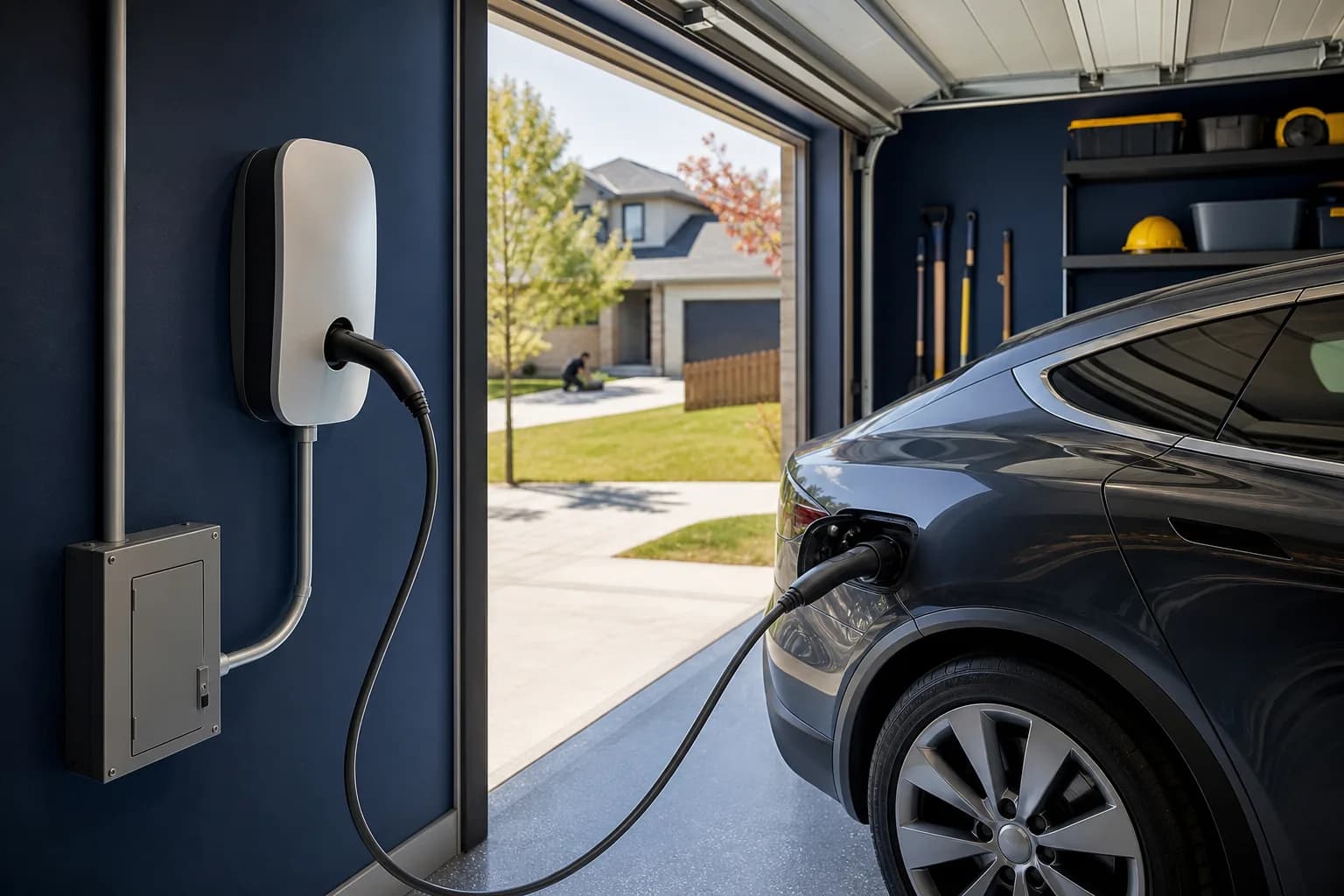
Most owners want it close to the charge port, on a garage wall or a post at the side of the driveway. ESA expects a charger and any pedestal to be protected from vehicles, by keeping it at least a metre from where cars park, mounting it higher, or adding a curb or bollard. Outdoor units need to be rated for the weather, and we route the cable so it isn’t a trip hazard in the dark.
Condos and townhouses
In a condominium, the charger usually connects to the building’s electrical system rather than your suite panel, and the board has to approve it. Building capacity is the real limit: without load management, every new charger is added at its full demand. We work with property managers on a plan that can grow, often a shared energy management system that divides the available capacity across many parking stalls, with metering so each owner pays for their own power.
Workplace and commercial chargers
For offices, hotels, dealerships and retail lots, we install networked Level 2 stations from brands such as ChargePoint and FLO, with access control and billing handled through the network provider. On a commercial site, we look at the panel capacity, trenching or surface routes to the stalls, bollards and the parking layout before anything is ordered.
Install day
- We confirm the charger model, location and amperage setting with you.
- We file the ESA notification.
- We run the circuit from the panel, mount the charger and set its maximum current to match the circuit.
- We test it with your vehicle, if it is home, or with a tester if not.
- ESA inspects, and you get the Certificate of Acceptance.
Most home installs take part of a day. To get a quote for yours, request a free quote and tell us the car, the charger if you have one, and a photo of your panel.
Published prices
CAD · before GST/HST
- Level 2 charger installationTypical of 5 published prices ($500 to $3,000 overall), 5 sources
- $1,100 to $2,500
- The charger unit itself
- $700 to $1,500
- Load management device instead of a panel upgrade
- from $999
- If the panel needs a 200 amp upgrade
- add $1,500 to $4,000
- ESA notification, EV chargerContractor fee, ESA 2026 fee guide
- $92
Published prices from Ontario electrical contractors’ own price guides, checked October 25, 2026: ranges, not quotes, and before HST. ESA fees are from ESA’s own 2026 fee guide. Your job gets a written quote after we see it.
Questions people ask
How much does EV charger installation cost in Kitchener?
Published Ontario prices for installing a Level 2 home charger are $1,100 to $2,500, not including the charger itself. Distance from the panel and whether load management or a service upgrade is needed make the biggest difference. Our EV charger cost guide explains each factor.
Can I install a Level 2 charger on a 100 amp service?
Often, yes. A load calculation shows how much spare capacity there is. If the charger doesn’t fit at full output, it can be set to a lower current or paired with an energy management system that slows charging when the house is busy.
Does an EV charger installation need an ESA inspection?
Yes. Adding a new 240 V circuit for a charger is work that needs a notification filed with the Electrical Safety Authority and an inspection. The licensed contractor doing the work files it.
Can you install a Tesla Wall Connector?
Yes. We install the Tesla Wall Connector and other major Level 2 chargers. We set the charger’s current to match the circuit and, for Wall Connectors on a shared setup, configure power sharing where it is used.
How long does it take to install a home EV charger?
A straightforward install near the panel usually takes a few hours. A long run to a detached garage, trenching, or adding an energy management device can make it a full day.